Urban Commuter Jackets: Silhouettes, Materials and Concealed Function
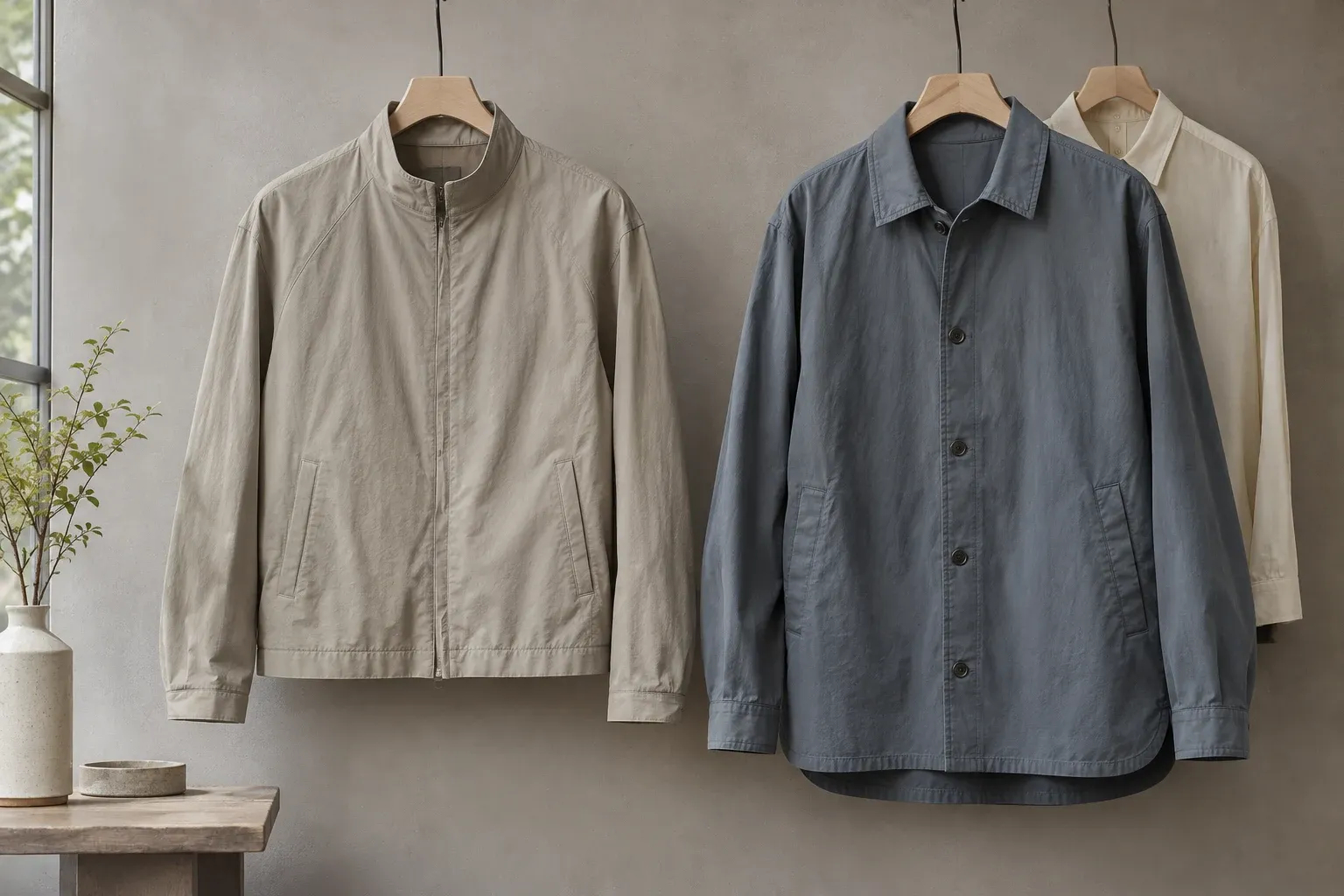
From stand-collar jackets to overshirts, explore shoulder–sleeve mobility, lightweight fabrics and discreet storage for commuting.
Start with a Day's Commute, Rather Than a List of Features
A lightweight commuter jacket may move through walking, public transport, the office and an evening out. Wearers need mobility and storage, seated comfort, packability and compatibility with everyday clothing. ‘Lightweight’, ‘hidden function’ and ‘multiple pockets’ are only directions; explain when these features are used during the day.
Prepare a scenario brief covering season and region, usual layers, backpack use, carried items and whether the jacket spends long periods on a chair or in a bag. This article discusses choices under these conditions without presenting candidate colors or styles as sales-validated trends.
Leaving Home: Choose the Silhouette, Then Layering Room
A cropped stand-collar jacket concentrates attention at shoulders and hem for compact volume; an overshirt emphasizes its open and fastened states; a lightweight longer jacket requires joint consideration of hem coverage, sitting and pocket placement. Choose against customers' existing layers and bottoms rather than only a front photograph.
Fit over the same shirt and then a thicker layer, recording chest, shoulder, upper-arm and neck changes. More chest circumference alone may not resolve sleeve or neckline crowding over thicker layers. Conversely, excess room intended for thick layers may bunch when seated if the jacket mainly accompanies thin layers.
A collection can share zippers, pocket language or colors without giving all three silhouettes identical structures. Changes in length and materials require renewed review of placket weight, sleeve direction and hem behavior.
At the Station and on Board: Review Shoulders, Sleeves and Closures in Motion
Reaching for a handhold, retrieving items, putting on a backpack and sitting reveal issues hidden in standing poses. For marked cuff ride-up, check sleeve shape, armhole and back room. For neckline displacement, find the source of body pulling before lowering the collar. Retain natural standing and movement states so one action does not lead to unlimited enlargement.
The placket affects everyday use too. Assess starting the zipper, button placement causing abdominal gaping when seated, and excessive collar bulk when open in actual fabrics and trims. For frequent indoor/outdoor transitions, dressing and partly open states may be more informative than fully closed photographs.
For adjustable hems, sit after tightening and observe cord and lock positions. Choose understandable, usable structures rather than add accessories requiring repeated rearrangement during a commute.
A Concealed Pocket Starts Working Only When It Holds a Phone and Cardholder
Load actual items before deciding opening size and depth. Overlapping outer and inner pockets can concentrate phones, pocketing and zippers, pulling the front down or making it bulge. Mark candidate positions on a sample and compare loaded standing, walking and sitting before fixing every line.
Backpack straps and belts change access. Shoulder straps may cover upper chest pockets; lower pockets may be difficult to reach when seated. Record items, carrying method and operating sequence so process staff understand why the same pocket needs repositioning.

A clean appearance depends on coordinated details. Narrow openings, concealed closures and lightweight fronts require checks of end reinforcement, reverse-side bulk and local puckering. Hiding the opening does not solve these issues; users still need to find and use it naturally.
At the Office: Consider Sound, Creasing and Feel
Compare softer cotton blends, densely woven fabrics or shirting-like materials according to use. Beyond touching swatches, make partial samples with plackets, pockets and cuffs to assess bending noise, thickness, crushed appearance and friction against inner layers.
For defined structure, check support for collars and pocket openings. For soft drape, assess whether interfacing, zipper tape and pocketing are too heavy. Check seam-allowance and pocketing show-through in light colors, and compare scuffing and post-care appearance in dark colors under similar light.
Before promoting water repellency or other functions, define the materials, finishing and validation records, and reassess after changes. Outdoor-inspired design structures and substantiated performance are separate matters.
Taking It Off in the Evening: Validate Packing Beyond the Diagram
For folding into a bag, validate actual garment volume and handling. Stiff zippers, thick pocketing and layered collars can hinder packing. Reassess silhouette and surface after unpacking and wearing again. Where packability is not a defined need, prioritize feel and appearance stability instead.
Packable pockets and separate bags should have understandable folding methods and genuinely fit the approved sample. Do not demonstrate only maximum cinching or complete flattening. Retain video of normal handling to show whether substantial force or repeated adjustment is required.
Post-care checks should likewise follow use, reviewing neckline, pocket openings, placket and dimensions rather than only obvious damage. Consistent care and resting conditions help compare material and structural options.
Simple Appearance Requires More Specific Manufacturing Information
Concealed pockets and narrow plackets offer little decoration to distract from waviness or asymmetry. Mark junctions requiring joint approval and provide front/reverse photographs and physical samples rather than ‘fine workmanship’. Inform purchasing early about special materials or sequences so alternatives can be compared.
Thinner pocketing may reduce bulk but must still meet storage and care needs. Removing a panel seam may improve continuity while changing pocket installation. Discuss these trade-offs in sample meetings: designers explain visual priorities and technical staff explain execution conditions. Selecting a repeatable solution is more effective than repeatedly asking for wrinkles to be pressed out later.
Build Collection References from One Basic Sample
In round one, establish shoulders, sleeves, length and primary layering relationships. Add actual fabrics and trims, carried items and care in round two. Mark affected areas for every change so simultaneous material, pocket-position and pattern revisions do not obscure what improved the result.
Compare three sets of evidence at final selection: full outfits, movement and storage records, and actual materials and manufacturing conditions. A more defined silhouette and a softer-feeling style can each have valid reasons. Retain those reasons as a reusable basis for later collar, color or length variations.
If round one reviews appearance only, explicitly record pending actual-material, care or performance confirmation. Later recipients can then distinguish a display sample from full production readiness and schedule around the actual remaining work.