Soft American-Inspired Women's T-Shirt and Sweatshirt Silhouettes
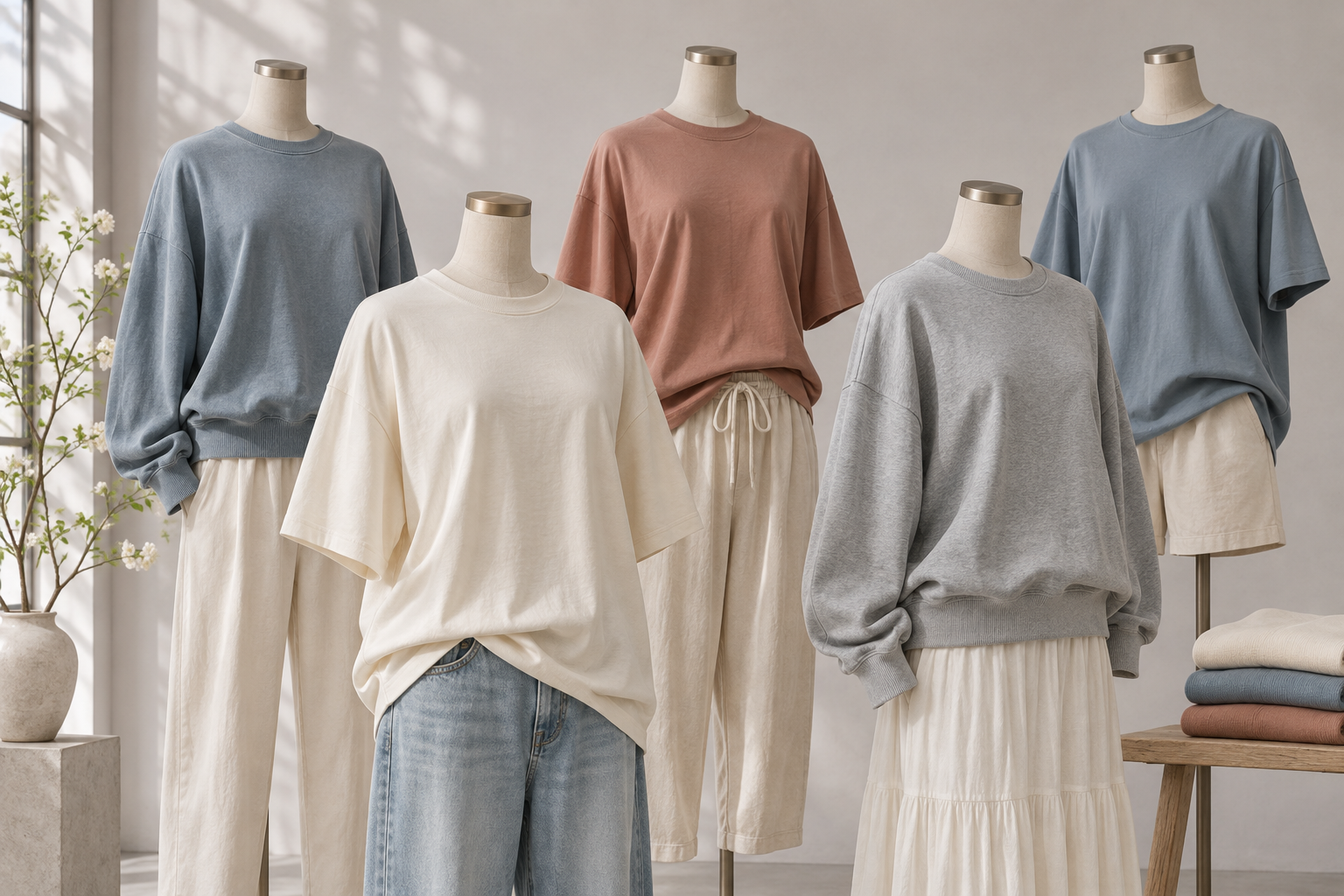
Explore how dropped shoulders, relaxed bodies, sleeve length and knit drape combine into an easy women's silhouette.
Understand ‘Soft American-Inspired’ as a Design Language First
Here, soft American-inspired describes communicable silhouette and material features: relaxed shoulders and sleeves, clear length relationships, knits suited to everyday layering and coordinating colors. It is not a judgment of market sales or popularity. Brands can select features using their customers, styling habits and existing basic patterns.
Relaxed fit is easily mistaken for enlarging every area. In development, shoulder line, armhole, sleeve width, chest and length must work together. More chest room alone may not create natural drape; simply lowering the shoulder point may misdirect the sleeve. Assess overall proportions first, then identify the structures producing them.
Three Silhouettes for Three Styling Questions
A relaxed T-shirt supports easy everyday styling, keeping neckline and sleeves controlled despite relaxed shoulders. A boxy silhouette concentrates volume in the body, requiring length, hem width and sleeve length to be assessed together. A long-line body must accommodate hip room, hem position and side balance, rather than merely extend a basic T-shirt downward.
Compare with the same bottoms and underlayer, photographing natural standing, side views and the state after raising arms. Cropped styles may balance high-waisted bottoms clearly, or expose more than intended after movement. Longer styles add coverage but may bunch when seated. Record the desired effect rather than declaring one silhouette universally better.
A collection can share neckline language or color groups without sharing an identical shoulder–sleeve solution. Different lengths and fabric weights redistribute volume, so allow corresponding pattern adjustments.
One Pattern, Two Fabrics: Identify What Changes First
Make the same basic style in a more supportive jersey and a softer, draping knit. Control graphics and trims, focusing on shoulder points, sleeve openings, side seams and hems. Supportive fabric may define boxy volume more clearly; soft fabric may make folds and drape the dominant visual features.
Do not choose the ‘better-looking’ one from photographs alone. Discuss hand feel, thickness, skin contact, care and target season together. If crisp shoulders and sleeves are required in very soft fabric, acknowledge that pattern and construction may both need adjustment. For natural drape, also check unwanted cling or show-through.
Recheck swatch-approved color and hand feel in the garment. Neck ribbing, shoulder stabilization and decoration add local weight and touch differences absent from a freely hanging swatch.
Dropped-Shoulder Sweatshirts Depend on the Shoulder–Sleeve Junction
Dropped shoulders create a relaxed look, but armhole depth, sleeve direction and underarm fabric distribution need joint assessment. A smooth standing appearance that lifts the whole garment during forward reach still requires force analysis. Simply enlarging the armhole may not resolve movement restrictions and may add bunching at rest.
Have wearers stand normally, then reach, raise arms and bend elbows in sequence. Record body ride-up, cuff movement past the wrist and neckline displacement. Compare revisions with the same actions, rather than another standing photograph from a different angle.
Hem and cuff ribbing bound relaxed volume. Strong gathering produces a bloused body; a looser finish creates a straighter silhouette. Assess sitting, layering and pushed-up sleeves before choosing, instead of approving flat width alone.
Trace Three Common Sample Issues to Their Causes
The Neckline Keeps Moving Backward During Wear
Check front-to-back balance, shoulders and posture before immediately reducing the neckline. Keep layers and fitting actions consistent with the previous version, then identify whether movement follows a particular action to distinguish basic balance from localized pulling.
Underarm Bunching or Persistent Twisting at One Side of the Hem
For underarms, examine the armhole–sleeve-width relationship and whether fabric is softer or thicker than planned. Investigate hem twisting through cutting, sewing and pre-/post-care records rather than hiding it by shortening the body. If it appears only after care, retain conditions and before-and-after photographs for the relevant team to review.
Retain comparable evidence: the same wearer, similar layers, the same actions and the corresponding sample version. This lets patternmakers distinguish proportion changes from changed wearing conditions. Clearly mark fabric substitutions so material differences are not attributed entirely to pattern revisions.
Some wrinkles are natural to a soft, relaxed silhouette. Before revising, distinguish intended effects from those hindering wear or causing imbalance. Pursuing complete smoothness from every angle may undermine the ease the design was meant to retain.
How Color and Decoration Keep a Collection Cohesive
Cream, gray-blue and muted warm colors are possible palettes, but final choices should reflect actual materials and customers. The same color looks different across knit structures, brushed surfaces and ribbing. Compare related materials under the same light rather than approving a whole material system from one screen color code.
Relate graphic placement to shoulder line, length and hem rather than applying one fixed distance. A large graphic on a relaxed cropped style may approach the hem; the same graphic may look too small on a long style. Review actual-size paper artwork on the wearer, then approve process samples and post-care condition.
For a collection with T-shirts and sweatshirts, a few shared colors, graphic elements or neckline details can connect styles while preserving each silhouette's purpose. This creates clearer relationships for separate sales and coordinated displays.
Retain a Basis for Further Development When Approving the Collection
Divide final documentation into basic patterns, material combinations and style variations. Basic-pattern records retain approved shoulders, sleeves and measurements; material records retain swatches and care observations; variations explain changes in length, ribbing and decoration. Design and purchasing can then distinguish reusable conditions from those needing resampling.
Approval covers specific conditions, not just words such as ‘soft’ or ‘relaxed’. Keeping appearance and movement photographs, material codes and revision reasons together gives these seemingly simple everyday products clearer direction across styles, colors and repeat orders.
For buyers, also identify each style's role: a replenishable basic, a key style offering stronger silhouette variation, or a development style exploring new materials. This clarifies relationships during ordering and avoids judging every style by the same degree of looseness.