Why Starting a Clothing Brand Can Feel Overwhelming
Begin with the first styles, fabric choices and sample validation, breaking your first collection into actionable steps.
A first collection can make everything feel simultaneous: products, materials, samples, visuals, packaging and sales. Start with a different question: what new information should the next investment provide? Organizing work around that question makes the pace easier to manage than completing every style at once.
Choose a Starting Point That Represents the Brand and Can Be Validated
The core style need not be the most basic or the most complex. It should express the brand's product direction and be testable through samples, fittings and real-use feedback. If distinctive cutting is central to the brand, a plain short-sleeved top without relevant structure may not answer the real product question.
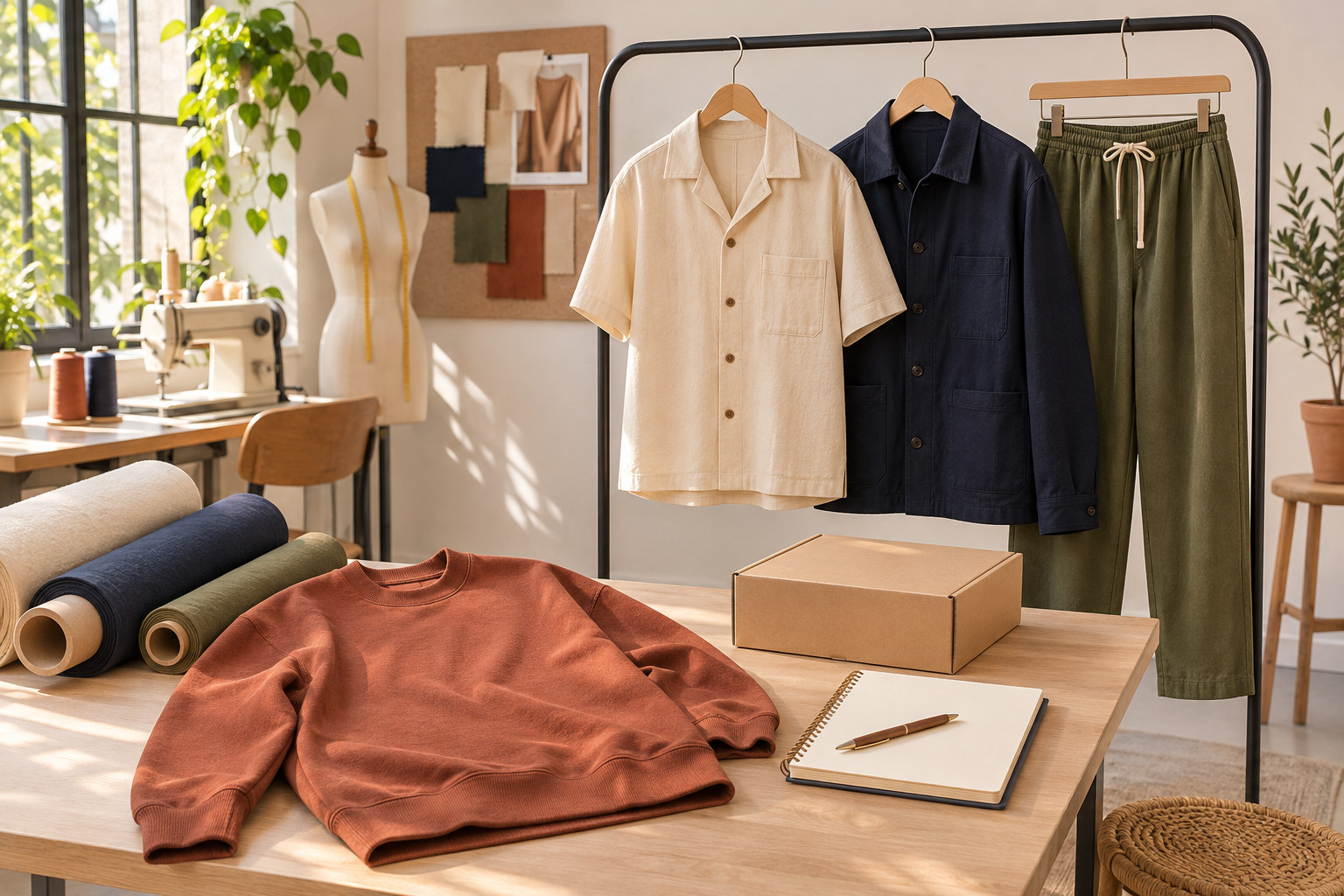
For each candidate, describe the target wearer, use, distinguishing features and manufacturing challenges. In a hypothetical urban casual collection, a cropped jacket expresses silhouette, an underlayer expresses color and trousers express coordinated proportions. Decide which piece carries the core validation and let others complement it, rather than developing materials and processes independently for every style.
Consider fallback options when choosing styles. If a key fabric cannot be supplied consistently, is there an alternative preserving the main experience? If a construction detail works only on a display sample, are you willing to change it? Discuss these early rather than after substantial investment.
Break the First Stage into Three Questions
Is the Product Direction Understood?
Use clear images, swatches or representative samples to ask target wearers when they would wear the product, how they would style it and what care they expect. Simply asking ‘does it look good?’ invites polite answers. Asking whether it would replace something in their wardrobe usually comes closer to actual needs.
Directional feedback is not a purchase commitment. Record whether feedback comes from existing customers, friends, potential buyers or social media viewers. Different sources answer different questions; approval from a few acquaintances cannot establish a conclusion for the whole audience.
Does the Product Experience Work?
At the sample stage, focus on actual materials, movement in wear and post-care condition. Feedback on a display sample made in temporary fabric establishes only part of the direction. Skin feel, transparency and support require the corresponding material. Before another round, state which evidence has been obtained and what is still missing.
Can Supply Conditions Support Sales?
After product approval, check material supply, size range, minimum production requirements, packaging and repeat-order arrangements. Completing the first order and supplying it repeatedly are separate questions. If a style relies on a chance find of deadstock fabric, decide early whether it is a limited edition or needs material developed for ongoing supply.
Plan Funding Around Its Purpose and Recovery Conditions
Development spending creates the product, validation spending assesses it, and scaling spending supports bulk supply. Distinguishing these purposes prevents an incurred development cost from automatically authorizing the next purchase. Past spending shows what has been done; new evidence determines whether continuing is worthwhile.
Separate costs that must occur early from those that can wait. Key patterns and material validation affect product viability; complete packaging and every color may be introduced in stages depending on the project. Deferral does not mean ignoring packaging and labels, but identifying when they must be completed.
Allow room for revisions, shipping, additional samples and testing. A plan covering only an ideal single sample and shipment may force validation to be dropped even for normal review. The allowance depends on product complexity and actual supply conditions; do not copy a universal percentage.
After the First Sample Passes, Check Back Against the Original Intent
Return the sample to its intended use. Does it still express the core features behind its selection? Have added interfacing, a different collar or revised length introduced to solve manufacturing issues changed its positioning? Development can make a concept achievable, but repeated compromises can also move it away from the original intent.
Then check whether user feedback points to the same issue. If most comments concern the same area in wear, prioritize explaining why. If comments reflect different style preferences, every one need not become a revision. Retain original wording and circumstances instead of only conclusions the team wants to hear.
Ask separately about size, color and price acceptance where possible. Liking a color does not mean the current size fits; willingness to try something on does not imply willingness to buy. Combining these answers into ‘the market looks promising’ hides what remains to be validated.
How to Decide Whether to Expand, Revise or Set It Aside
Expand the RangeThis suits cases where the core experience works and new variations have a clear purpose. Share established structures or materials to reduce duplicate development, but check whether new combinations introduce new problems.
Continue RevisingThis suits cases with a clear problem, a manageable revision scope and intact core product value. Each revision should answer a new question; do not keep resampling merely because no better direction has emerged.
Set It Aside for NowThis suits cases where the essential experience cannot be achieved, supply conditions remain unsuitable, or target-user feedback differs markedly from the original assumptions. Retain the material and pattern knowledge for future use. Stopping one product does not reject the entire brand.
Before bulk production, list unresolved issues and distinguish local visual effects from changes to wear, safety, sales or delivery conditions. For the latter, obtain relevant evidence before deciding scope and quantity. When the team disagrees about risk, comparing specific consequences and room to reverse course is more useful than debating whether to ‘take the leap’.
The Lasting Results of a First Collection
Beyond saleable products, retain validated patterns, material descriptions people can work with, effective fitting methods and a real understanding of users. These reduce blind spots in the second collection and help the brand decide whether to add styles, improve sizing or first refine existing products.
Control the dimensions of change in the first collection. A new product introducing a new fabric, pattern and decoration significantly increases the questions to answer. Reasoned variations on an established foundation are easier to interpret. Controlling scope does not mean making every product look alike; it means providing enough resources to validate each change.
Plan sample retention early too. Keeping final approved samples and key unsuccessful panels helps identify future issues. A failed sample labeled only ‘bad’ offers little value. Record what question it addressed and why it was rejected so the same path is not unknowingly repeated.
Development need not solve every future problem at once. Let each stage produce clear new understanding and use it to guide the next investment, helping collection size grow alongside team capability.