Athleisure Sets: Coordinated Proportions, Stretch Fabrics and Paneling
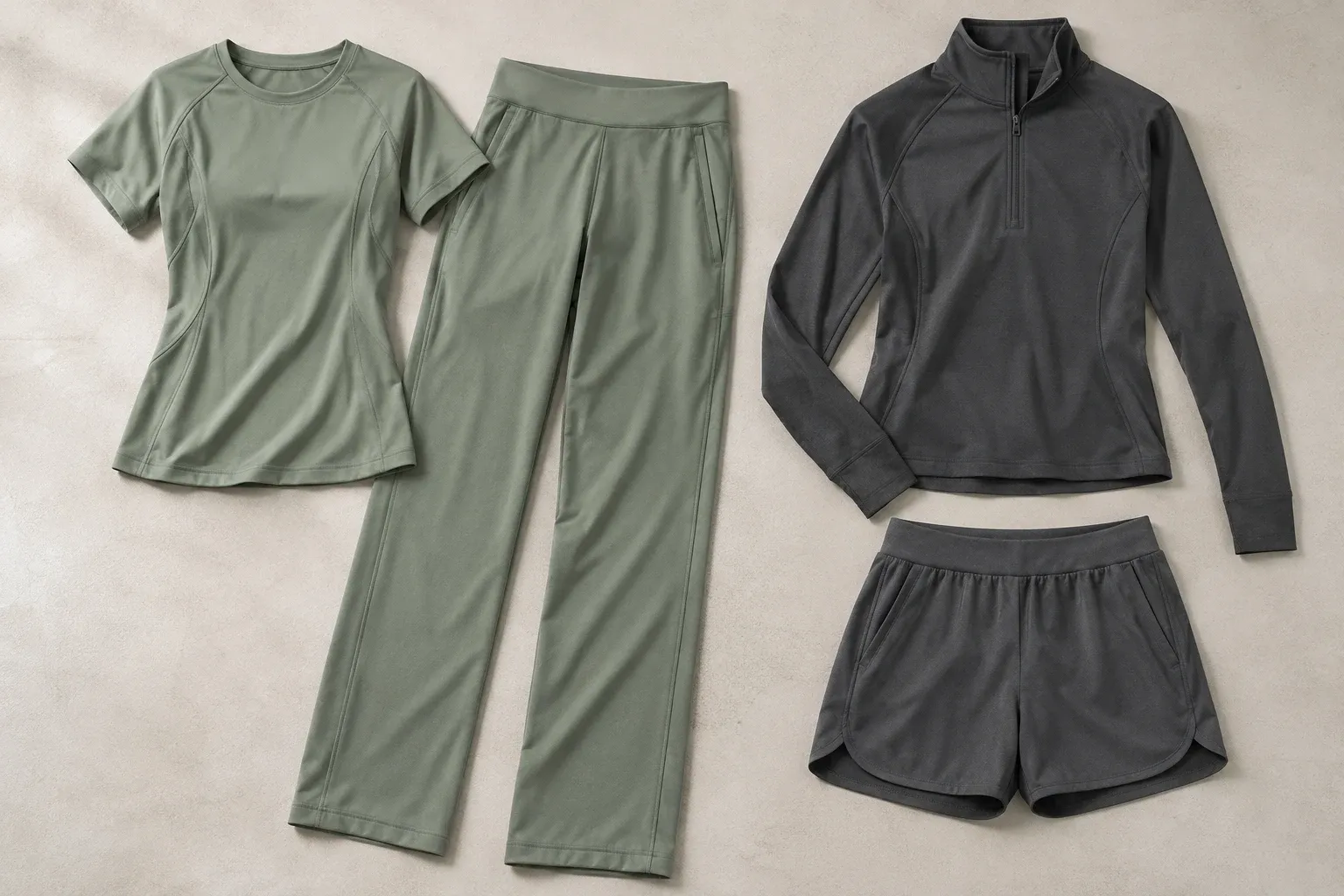
Assess tops and bottoms in one wearing scenario to observe how waistbands, pockets, seams and material recovery work together.
Define ‘Coordinated Set’ in a Product Brief First
An athleisure set may provide relaxed travel wear or support short activities after commuting. Close-fitting training creates different support, coverage and movement needs. Choose the main use before fabrics and paneling instead of combining feature words from every scenario.
Start with five questions: who wears it, when, which main movements, what they carry, and whether pieces sell separately. The last is often missed. A top working only in set photographs may be hard to style alone; independently suitable trousers may lack clear proportions with the matching top.
This article offers collection-development approaches; it does not present any particular palette or style as a market-validated mainstream choice. Actual selection still needs the brand's own customer and sales evidence. Claims of moisture absorption, quick drying or other performance also require links to the corresponding materials and test documentation.
Three Candidate Combinations with Different Volume Distribution
Short-Sleeved Top and Straight-Leg Trousers: Prioritize Everyday Separate Wear
A simple top can pair with varied bottoms; straight trousers need mobility at waist, crotch and knees. Choose top length beyond front proportions, assessing coverage and bunching after sitting, raising arms and carrying a backpack. Review trouser openings with footwear to avoid discrepancies between sample outfits and planned displays.
Half-Zip Top and Shorts: Emphasize Openings and Storage
Prioritize collar height, closed-zip feel and open drape on the top. Structure shorts around waist adaptation and carrying needs. Many zippers, adjusters and patch pockets on both pieces can make the set heavy. Choose one clear functional focus and keep the other piece relatively simple.
Cropped Top and High-Waisted Bottoms: Define Coverage After Movement
Their relationship changes with arm raising, bending and sitting. Record intended exposure rather than classify every exposed area as a problem. Assess waistband height against torso proportions and sitting, not flat measurements alone.
The three options can share colors or stitching language without identical shoulders, sleeves, waistbands and pockets. Each piece has a different task and should allow structural variation.
Shared Fabric or Separate Materials for Tops and Bottoms?
Shared fabric eases visual coordination, but stress and abrasion locations differ. Tops prioritize shoulder–sleeve mobility and neckline stability; bottoms also need knee, seat, waist and loaded-pocket assessment. Fabric soft enough for a top may lack support where trousers need it.
Review in two steps: compare same-fabric sets, then visually similar combinations with different constructions. Record feel, surface, thickness, recovery and post-care observations each time. Hand-stretching a swatch alone cannot establish elasticity in a garment, where seams, waistbands and pocketing alter behavior.
For matching colors across fabrics, approve body, ribbing, zipper tape and decorative panels together. Smooth and textured surfaces differ visually; separately approved color samples may not coordinate together. Photographs document results, while physical samples remain important references.
The Waistband Need Not Use the Body Fabric
A waistband supports the garment and dressing while visually connecting top and trouser body. Compare inner feel, joining bulk and relaxed width separately. A wide waistband may look stable yet be uncomfortable seated; a softer option may ease dressing yet move during activity. Review on an actual trouser body, not an isolated ring, to see joint loading.
If the set includes shorts and trousers, waistband language may remain consistent, but pockets, weight and movement requirements differ and each needs fitting. Approval of the top or one bottom does not cover the entire range.

Paneling needs a clear task: shaping volume, allocating materials or creating collection identity. If lines are purely visual, first assess seams' effects on inner feel and stretch. For many-seamed styles, use continuous movement to locate recurring rubbing or pulling before retaining each line.
Record Four Issue Types Separately in a Full-Set Fitting
Start with standing proportions, then sit, raise arms, reach and squat; finally load intended items and walk again. Instead of ‘average comfort’, record observations in these categories.
- Coverage issues: Does the top roll up, and does the hem land as intended? Check length, hem structure and upper-body tension before simply lengthening it.
- Waist issues: Does the waistband fold, pinch or slip down? Assess material, waistband width and trouser balance together, not circumference alone.
- Seam issues: Where does rubbing occur, and during which movement does pulling happen? Record seam location, construction and reverse side rather than immediately replace every stitch type.
- Carrying issues: Do pocket openings gape, do items bounce, and are they easy to retrieve? Also assess pocket-bag anchoring and body ease.
Photograph standing posture again after movement to assess recovery at knees, seat, elbows and waist. Repeat under the same conditions after care to distinguish temporary creasing, material changes and dimensional changes. Tests and criteria follow project goals; internal fitting records do not replace performance evidence.
Review the Set, Separate Wear and Future Variations Together
Before approving the set, prepare photographs of the top and bottom worn separately and with different layers. If a piece works only in a specific color combination, define its collection role. For a long-term basic, discuss connections with other products through colors, necklines or pockets.
Do not assume all earlier results carry over to new sleeve or leg lengths or added graphics. Shorts extended into trousers change knee/opening relationships; a crewneck changed to a half-zip changes collar weight and front drape. Retain approved conditions and list changes requiring validation each time to control collection development.
Final handover should include combination logic, individual measurements, material/color links, revisions and fitting conditions. Design, purchasing and production then see the same decisions: shared language, each garment's own use needs and questions awaiting another sample.
Leave room for trade-offs in range planning. If a new material makes color coordination harder, ask whether it adds sufficiently clear wearing value. Simplify paneling that adds operations without improving silhouette or use. Professional set documentation explains retention and removal decisions rather than giving every piece equal numbers of features.